

Making better decisions isn't about finding a single magic trick. It's a skill you build by blending clear-headed processes, self-awareness, and physical health. This is your system for improving how you think, understanding why you think that way, and ensuring your body is firing on all cylinders to support your mind.
The Modern Challenge of Making Better Decisions
In today's professional world, the sheer volume of choices can feel like a tidal wave. Leaders constantly face high-stakes decisions, leading to a state of mental gridlock called decision paralysis. This isn't just a vague feeling of being overwhelmed; it’s a real phenomenon that kills performance and puts a serious dent in your well-being.
The pressure to make the right call every time is massive. A recent study found 77% of UK business leaders made more high-level decisions in the past year, with over half admitting to feeling stuck. The main culprits? Growing business complexity and constant economic pressure, which naturally dial up stress and anxiety.
Move Beyond Simple Tips
To genuinely improve your decision making, you need to go deeper than quick hacks. The goal is to build a reliable system that works for you every day. This means taking a complete approach that weaves together:
- Structured Processes: Use proven tools like decision matrices or mental models to bring objectivity to the table.
- Psychological Awareness: Learn to spot and sidestep the cognitive biases that quietly nudge your judgment in the wrong direction.
- Physiological Optimisation: Realise that your physical state—how you sleep, what you eat, and your stress levels—has a direct line to your mental clarity.
This guide is your toolkit, packed with practical strategies to help you get back in the driver's seat with confidence. When you're dealing with complexity, exploring dedicated strategies for faster decision making can also give you an extra edge.
By focusing on these core pillars, you can shift from feeling swamped to making choices with real conviction.
To help you get started, here's a quick overview of the framework we'll be building on.
Quick-Start Framework for Better Decisions
| Pillar | Core Action | Primary Benefit |
|---|---|---|
| Clarity & Structure | Define clear goals and use structured tools. | Removes ambiguity and emotional bias from the process. |
| Mindset & Awareness | Identify and actively counter cognitive biases. | Leads to more rational and well-rounded judgments. |
| Physiology & Energy | Optimise sleep, nutrition, and stress levels. | Enhances mental stamina and cognitive function. |
| Habits & Rituals | Build consistent routines for decision-making. | Reduces mental fatigue and makes good choices automatic. |
Think of this table as your roadmap. Each pillar builds on the last, creating a powerful, holistic system for making consistently better decisions.
Build Your Decision-Making Toolkit
Moving from theory to practice means having the right tools for the job. You wouldn't use a sledgehammer for delicate work, and the same goes for decision-making. Building your toolkit is about knowing which framework to pull out to bring structure and clarity to a difficult choice.
For many day-to-day decisions, a simple Pros and Cons list is surprisingly effective. It’s quick, straightforward, and forces you to spell out the potential upsides and downsides. This is perfect for lower-stakes scenarios, like deciding whether to adopt a new communication app for your team.
This simple infographic highlights the first step in tackling decision overload: recognising when you need a more structured approach.
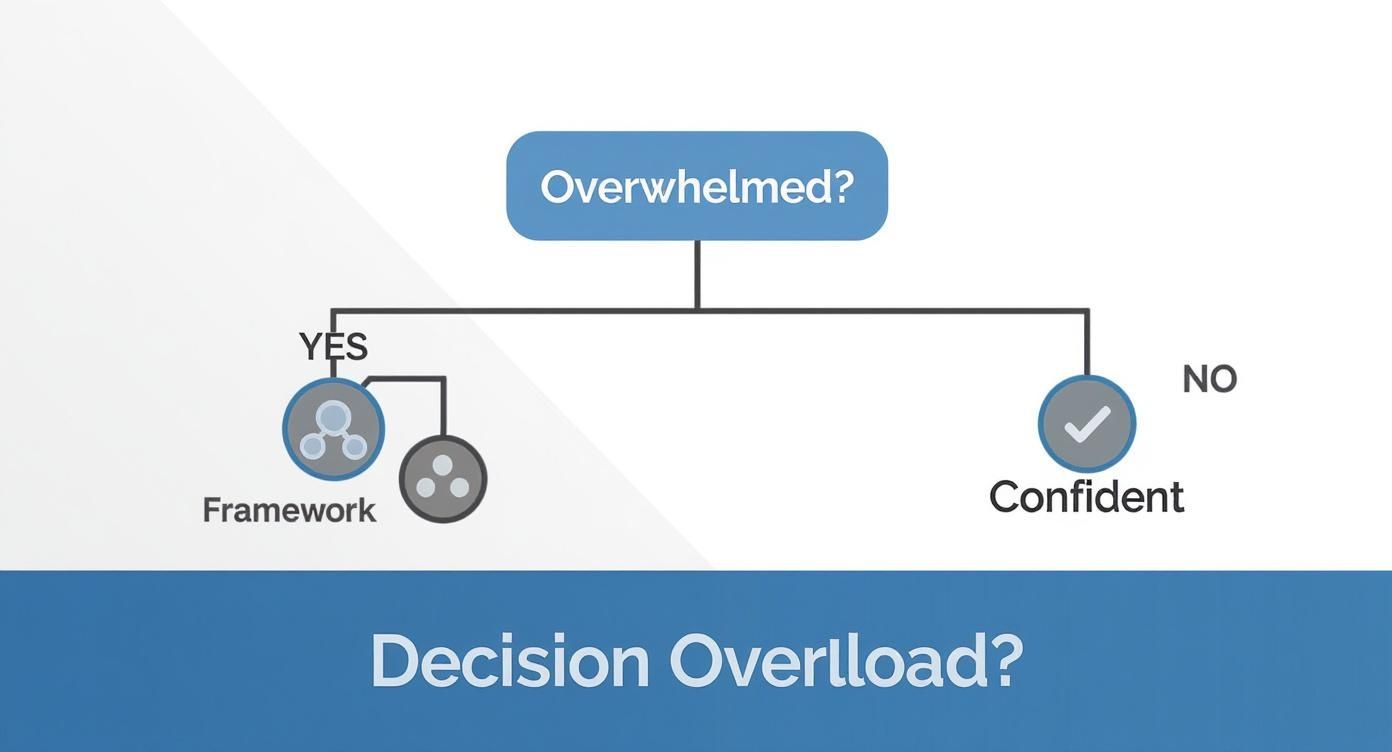
The real takeaway here is that just acknowledging you're overwhelmed is the trigger to engage a framework. It’s what stops you from getting stuck and helps you move forward with confidence.
Use a Decision Matrix for Complex Choices
When the stakes are higher and you're juggling multiple options with several important factors, a Pros and Cons list won't cut it. This is where a Decision Matrix becomes your best friend. It gives you a weighted, objective way to compare apples to oranges.
Here's how to create one when choosing a new software vendor, where your criteria might include cost, ease of use, and support:
- List your options down the left side of a table.
- List your criteria across the top.
- Assign a weight to each criterion based on its importance (e.g., cost is 5, integration is 3).
- Score each option against each criterion (e.g., from 1-10).
- Multiply the score by the weight in each cell, then total the scores for each option.
This process pulls you away from "gut feelings" and forces a logical evaluation, making the best choice mathematically clear. It’s also a powerful way to justify a decision to stakeholders and prove you’ve considered all the angles.
By systematically evaluating each option against predefined, weighted criteria, you transform a subjective debate into an objective analysis. This removes emotional bias and provides a defensible rationale for your final choice.
Adopt the OODA Loop for Fast-Paced Environments
Not all decisions can be made at a leisurely pace with a spreadsheet. In dynamic, fast-moving situations, you need a framework built for speed and adaptation. Use the OODA Loop—Observe, Orient, Decide, Act.
Developed by military strategist John Boyd, this four-step process is a continuous cycle:
- Observe: Gather real-time information about what’s happening.
- Orient: Analyse the data, considering your biases and past experiences, to form an accurate picture of the situation.
- Decide: Based on your orientation, choose the best possible course of action.
- Act: Execute your decision swiftly.
Imagine a project manager facing an urgent client request that could derail the current sprint. Instead of panicking, they apply the OODA Loop. They observe the request's details, orient by assessing its impact on the timeline, decide on a modified plan, and act by communicating it to the team.
This framework is less about finding the perfect answer and more about making the best possible move right now, then cycling back through the loop to adjust.
A huge part of building this toolkit is developing the ability to rigorously evaluate information. Learn to actively question and assess your options to improve your critical thinking skills and strengthen your "Orient" phase. These structured tools are designed to directly support your brain's ability to process information, a key aspect we discuss in our guide on how to improve cognitive function.
Confront Hidden Cognitive Biases
Even with the best tools, your decision-making can be derailed by your own mind. We all have cognitive biases—mental shortcuts our brains use to navigate a complex world. They're often helpful, but they can also lead to massive errors in judgment, especially when the stakes are high.
Learning to make better decisions means dragging these hidden forces out into the light. They operate just below the surface, quietly shaping how we see things and pushing us toward conclusions that feel right but are often flawed.
The goal isn't to get rid of biases completely; it's to become aware of them and build systems to keep them in check.
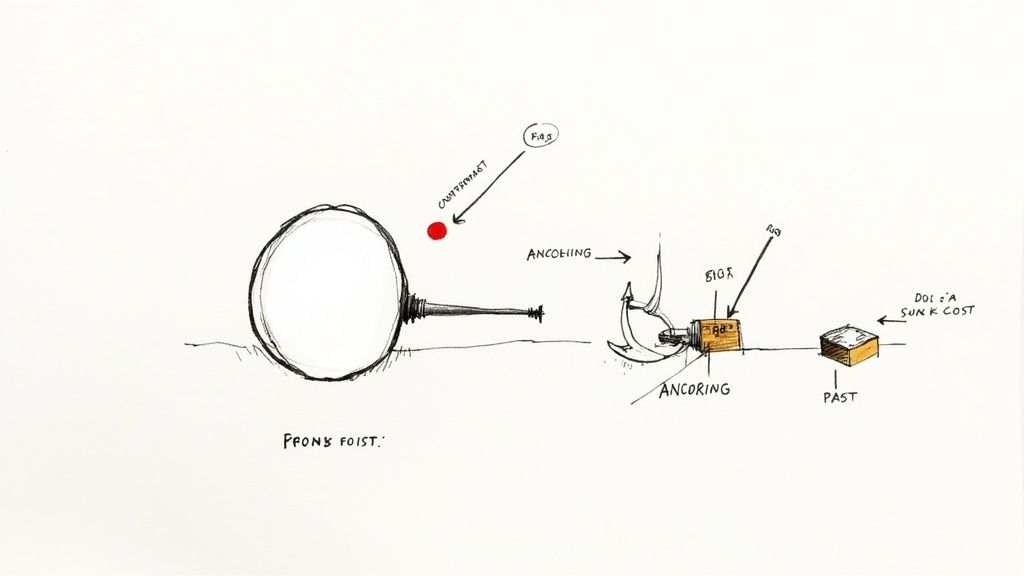
Action Step: Counter Confirmation Bias
The most common trap is confirmation bias: our habit of seeking out information that lines up with what we already believe. We filter out anything that contradicts our gut feeling, creating an echo chamber that reinforces our first thought.
A marketing manager convinced their new campaign is brilliant will latch onto data that supports their vision while dismissing reports that flag risks. This creates a dangerously skewed picture.
To fight this: Appoint a 'devil's advocate' in team meetings. Make it their job to challenge the popular opinion and poke holes in the main argument. This forces everyone to look at the problem from a different angle.
Action Step: Overcome Anchoring Bias
Anchoring is where we get stuck on the first piece of information we hear. This initial "anchor" heavily influences every judgment that follows, even if it was completely random.
Salary negotiation is a classic example. The first number thrown out sets the tone for the entire discussion. The same goes for project budgets; an initial cost estimate can anchor all future conversations.
To overcome this: Deliberately hit the reset button. Before you weigh an option, gather multiple data points from independent sources. If someone gives you a number, mentally set it aside and do your own homework from scratch before letting that initial figure colour your thinking.
"You need to be willing to engineer in conflict, which is often perceived as uncomfortable, but is essential to uncovering some of the hidden assumptions and data that leads people to make less-informed decisions."
Basically, creating a space for healthy disagreement isn't just a "nice-to-have"—it's a core strategy for making smarter, more objective choices.
Action Step: Avoid the Sunk Cost Fallacy
The sunk cost fallacy is that nagging urge to keep going with something just because you've already invested time, money, or effort into it—even when it's obvious the project is failing. We find it hard to cut our losses because it feels like admitting we were wrong.
Think of a company that keeps pumping money into a failing software project. The extra cash isn't going in because the project shows promise, but to justify the money already spent.
To avoid this: Use zero-based budgeting. Instead of basing this year's budget on last year's, force every expense to be justified from the ground up. This makes you evaluate a project on its current merit, not past spending, making it easier to kill ideas that no longer make sense.
Don't Drown in Data—Learn to Swim
We live in a world overflowing with information. It’s easy to think more data automatically equals better decisions. But often, the opposite happens. Leaders get stuck in 'analysis paralysis', staring at dashboards that just create more confusion.
The trick isn't to gather more data; it's to become data-informed, not data-driven to the point of inaction.
Stop collecting every scrap of information. Instead, identify the few key metrics that actually matter. Before you look at a single number, ask yourself one question: What am I trying to achieve here? Starting with a clear goal helps you identify the Key Performance Indicators (KPIs) that show you whether you're getting closer to it.
Find the Signal in the Noise
Once you know what to look for, you can start making sense of your data. A recent Experian report found that while 74% of UK businesses are trying to use data for real-time decisions, a massive 81% are held back because their information is scattered across clunky systems. You can dig into the full report on the challenges UK businesses face with data management if you're curious.
This data chaos is a huge roadblock. To make better decisions, you must bring the important stuff together. Here are a few practical actions:
- Build a Central Dashboard: Use one tool to pull in your most critical KPIs. This gives you a single, clear picture and stops you from hunting for numbers on ten different platforms.
- Set Clear Thresholds: Decide what 'good' and 'bad' look like for each KPI. This helps you spot problems at a glance without obsessively tracking every little fluctuation.
- Schedule Data Reviews: Set aside specific time to review your data. This stops you from making panicked, reactive choices and encourages strategic thinking.
Harness the Power of Human Insight
Data is great at telling you what is happening. It rarely tells you why.
Relying on numbers alone can be misleading. To get the full picture, balance hard data with qualitative, human insights. This adds context, nuance, and the real story behind the statistics.
A purely data-driven decision might look perfect on paper but fall flat in the real world. Blending in human experience and feedback keeps your choices grounded in reality, not just abstract figures.
Let's say your sales figures (quantitative) show a sudden drop. The numbers won't tell you why. But a quick chat with the local sales team (qualitative) might reveal that a new competitor just launched an aggressive pricing campaign. Without that on-the-ground intel, you'd likely misdiagnose the problem.
Here's how to gather these crucial insights:
- Talk to Your Team: The people on the front lines—in customer service, sales, or operations—are sitting on a goldmine of qualitative data.
- Listen to Your Customers: Use surveys, interviews, and reviews to hear directly from the people who use your product or service. What are they really thinking?
- Look for Anecdotes: Pay attention to the patterns in casual conversations and informal feedback. Important clues often pop up in an offhand comment, not a formal report.
When you combine hard numbers with these human stories, you move beyond just looking at data to truly understanding what's going on. This balanced view is the secret to making smart, robust decisions.
Optimise Your Physiology for Clearer Thinking
You can't separate mind from body. High-level decision-making isn't just a thought process; it's a biological one. Your brain is a physical organ, and its performance is directly linked to your body's overall health. If you neglect your physiology, you're trying to run sophisticated software on busted hardware.
To consistently think clearly, you have to give your brain the right fuel. Treat sleep, stress, and nutrition not as afterthoughts, but as the bedrock of your cognitive performance.
Action Step: Prioritise Restorative Sleep
Sleep is when your brain cleans house. While you're in deep sleep, your mind consolidates memories, processes information, and flushes out metabolic junk that leads to sluggish thinking. Chronic sleep deprivation hammers your judgement, creativity, and problem-solving ability.
Take Action: Aim for 7-9 hours of quality sleep every night. Stick to a regular sleep schedule, even at weekends. This stabilises your body clock, making it easier to fall asleep and wake up feeling sharp.
A well-rested mind is calm, focused, and objective. A tired mind is reactive, emotional, and far more susceptible to the cognitive biases we talked about earlier. Think of sleep as your non-negotiable mental reset.
Action Step: Actively Manage Your Stress Response
When you're constantly stressed, your body is flooded with cortisol. This stress hormone can impair the function of your prefrontal cortex—the part of your brain responsible for rational thought. Your brain defaults to a primitive "fight or flight" mode, which is terrible for making nuanced, long-term decisions.
Take Action: Use box breathing to hit the brakes on the stress cycle before a big meeting or a tough choice.
- Inhale slowly through your nose for a count of four.
- Hold your breath for a count of four.
- Exhale slowly through your mouth for a count of four.
- Hold your breath again for a count of four.
- Repeat this for a few minutes.
This simple exercise instantly calms your nervous system, lowers your heart rate, and brings your rational mind back online. If you're struggling with persistent mental sluggishness, learn more about how to clear brain fog and get your clarity back.
Action Step: Fuel Your Brain with Smart Nutrition
The food you eat directly builds and powers your brain. A diet packed with processed foods, sugar, and unhealthy fats promotes inflammation and oxidative stress, which damages brain cells and clouds your thinking.
Take Action: Bring more of these brain-boosting foods into your meals:
- Omega-3 Fatty Acids: Found in oily fish like salmon, plus walnuts and flaxseeds. These are essential for building healthy brain cell membranes.
- Antioxidants: Think berries, dark leafy greens, and dark chocolate. They're loaded with compounds that fight cellular damage in the brain.
- Adaptogens: Natural substances like Shilajit provide essential minerals and fulvic acid, which can help fight fatigue and support your mental stamina.
By getting your physiology right, you create the biological foundation you need for peak mental performance. You’re making sure your brain is ready to fire on all cylinders when it matters most.
From Action to Habit: Turning Good Decisions into a System
Making one great decision is a one-off event. Building a system that produces them consistently is a real advantage. The end game is to move away from stressful, last-minute choices and into a deliberate, almost automatic practice. This isn't about piling on more work; it's about creating habits that free up mental energy and sharpen your judgement over time.
This shift requires you to be intentional about your environment and schedule. Instead of waiting for the next big decision to land on your desk, build rituals that make strategic thinking a normal part of your week.
Action Step: Create a Weekly Strategy Block
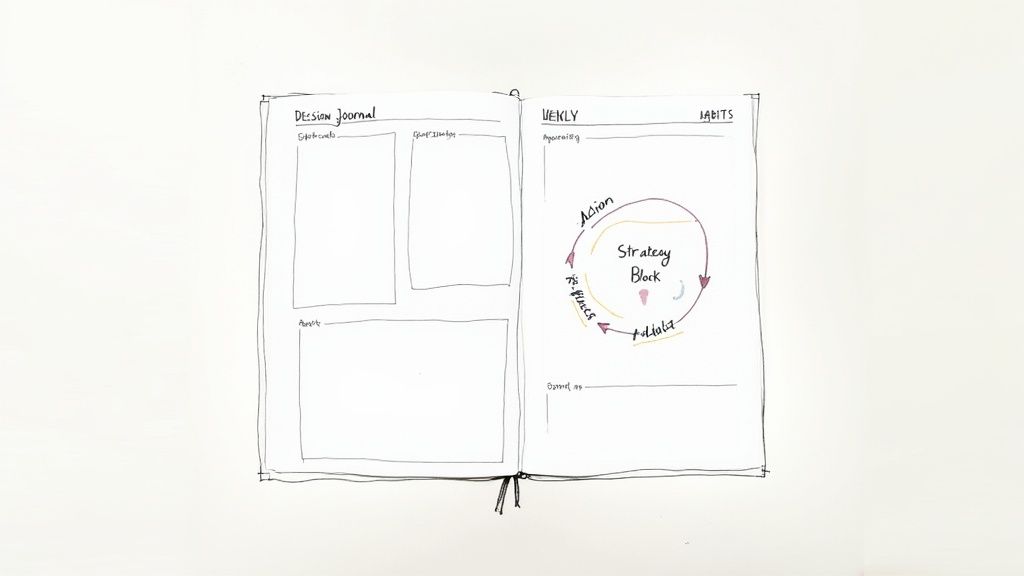
One of the most powerful rituals you can adopt is scheduling a recurring 'strategy block' in your calendar. This is protected time. Maybe it's just an hour every Friday afternoon, but it’s your time to reflect on key choices without the pressure of daily fire-fighting.
A recent NerdWallet UK survey found that business owners spend only 6.8 hours per week on strategy and planning—less time than on sales or AI. This shows how vital it is to carve out these dedicated moments for high-level thinking. You can dig into the full details of how UK business owners are prioritising their time in their research.
During this block, you can:
- Review the outcomes of recent decisions. What worked? What didn't?
- Look ahead and anticipate choices coming down the line.
- Think through long-term challenges without constant interruptions.
This simple habit changes the game, shifting decision-making from a reactive scramble to a proactive discipline. Protecting this time is easier when you know how to focus better at work and can keep distractions at bay.
A dedicated strategy block acts as a pressure release valve. It gives your most important decisions the time and mental space they deserve, preventing them from being rushed or made with a cluttered mind.
Action Step: Keep a Decision Journal
Another brilliant tool is a Decision Journal. This isn't a diary for your feelings; it's a structured log for tracking your choices and learning from them. Your journal creates a feedback loop that's often missing in professional life, helping you spot patterns in your own thinking over time.
For each significant decision, make a quick entry using this template.
Decision Journal Template
| Section | Prompt |
|---|---|
| The Choice | What decision did I make? |
| The Context | What was the situation and the information I had? |
| Expected Outcome | What did I expect to happen and why? |
| Actual Result | What was the real outcome? |
| Key Lesson | What did I learn from the difference between expectation and reality? |
Over time, this journal becomes your own invaluable, personalised database. It will reveal your biases, highlight what information you tend to overvalue (or ignore), and give you concrete evidence of your growth. It transforms every choice, good or bad, into a lesson that sharpens your judgment for whatever comes next.
At Oji Shilajit, we believe that peak mental performance is built on a foundation of consistent, healthy habits. Just as a decision journal builds your strategic mind, our Shilajit gummies are designed to support your cognitive foundation, providing the essential minerals your brain needs for clarity and focus. Discover how Oji Shilajit can become part of your system for success.


