

To improve how you perform at work, the secret isn't doing more – it’s working smarter. This guide provides a practical framework to build a solid, sustainable system that combines smart planning, deep focus, and personal well-being.
Your Framework for Better Work Performance
The pressure to be more productive is relentless. In the UK, productivity growth has been a challenge, with the Office for National Statistics showing that in Q2 2025, output per hour worked only nudged up by 1.5% compared to pre-pandemic levels.
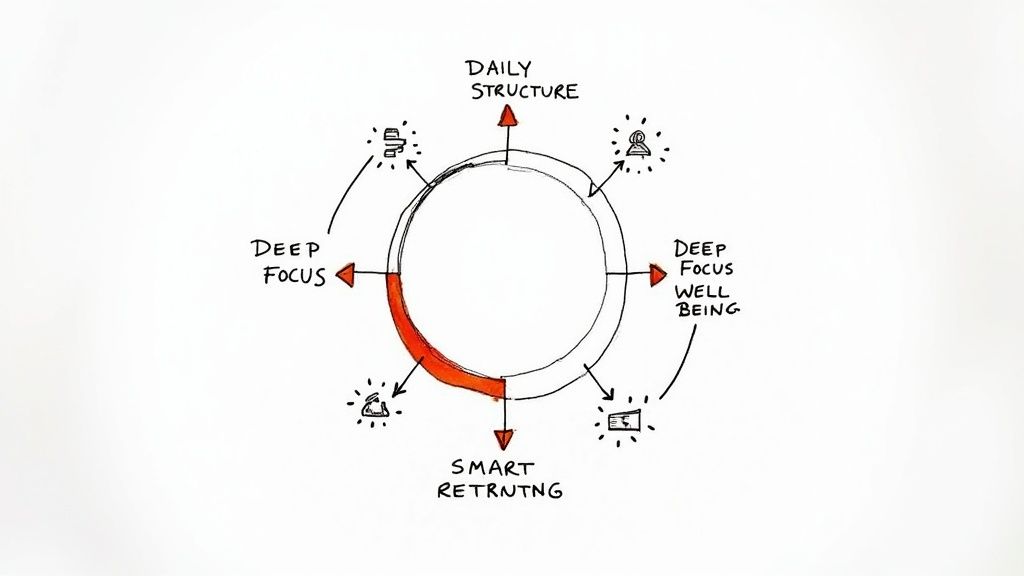
This guide moves beyond generic advice to give you a structured path for making real improvements. It focuses on interconnected pillars that create a powerful foundation for high performance.
Acknowledging the Real Challenges
First, let's acknowledge the obstacles: constant notifications, digital distractions, and the risk of burnout can hinder even the most driven individual. This guide is about building a robust framework to navigate these challenges effectively.
The following pillars work together to create lasting change. Use this as your personal roadmap for making meaningful, sustainable improvements in your professional life.
Key Pillars for Improving Your Work Performance
| Strategy Pillar | Primary Focus | Expected Outcome |
|---|---|---|
| Daily Structure | Intentional workday design | Greater control over your time and output. |
| Deep Focus | Creating a distraction-free environment | Higher quality work in less time. |
| Personal Well-being | Fuelling your mind and body | Sustained energy and resilience against burnout. |
| Smart Tools | Adopting simple, effective tech | Streamlined workflows and less manual effort. |
By focusing on these four areas, you can build a system that supports your ambitions without sacrificing your health.
Building a foundation for higher output starts with understanding how to collectively improve. For those in leadership roles, it’s worth exploring some proven tips to improve team productivity to support your entire group's success.
Master Your Day Before It Masters You
High performers control their hours with intention. To elevate your work performance, you must shift from reacting to fires to proactively planning your day. This isn't about rigid schedules but a flexible framework that protects your focus and directs your energy.
Build Your Day with Time Blocks
Take back control with time blocking. This is where you schedule specific chunks of your calendar for dedicated work. Instead of a long to-do list, you assign windows for related tasks.
Here's an actionable example for a project manager:
- 9:00 - 9:30 AM: Sync with the team and define daily priorities.
- 9:30 - 11:30 AM: Uninterrupted work on a critical project analysis. Turn off your phone.
- 11:30 - 12:30 PM: Process emails and send stakeholder updates.
- 1:30 - 3:00 PM: Schedule collaborative meetings and brainstorming sessions.
- 3:00 - 4:30 PM: Complete administrative tasks like updating project plans and reports.
A graphic designer might create larger four-hour blocks for creative work, pushing meetings to the start or end of the day. The core action is to defend your high-focus periods from low-value interruptions.
Eat That Frog First Thing
Pair time blocking with the "Eat the Frog" method. This actionable step is simple: identify your single most important and challenging task for the day—your "frog"—and tackle it first.
Completing this task creates powerful momentum. Even if the rest of your day gets derailed, you've secured a major win. This directly combats procrastination by removing the psychological weight of a daunting task early on.
"By completing your most difficult task first thing in the morning, you create a powerful feeling of accomplishment that boosts your energy and motivation for the rest of the day. It's a psychological hack that directly translates to better performance."
Prime Your Brain with a Pre-Work Routine
Start your morning with a routine that wires your brain for focus. A simple 15-minute ritual can transform your output.
Here are actionable steps to include:
- Quick Goal Review: Spend five minutes reviewing your time-blocked calendar and identifying your "frog."
- Hydrate First: Drink a large glass of water before coffee to kick-start your metabolism and brain function.
- No Emails Before Planning: Avoid opening your inbox until you have a clear plan for your first work block. This prevents you from immediately falling into a reactive mode.
This intentional start puts you in control of your day.
Finally, managing the pressure that comes with a demanding workload is key to performing at your best day after day. For a deeper dive, check out our guide on how to reduce workplace stress.
Unlock Deep Work and Eliminate Distractions
Your most valuable work happens during "deep work"—a state of complete focus. Reaching this state requires a deliberate strategy to reclaim your attention and build an environment that protects it from the constant barrage of notifications.
The modern workplace is designed for interruption. Despite an eight-hour day, UK employees report being productive for only about 2 hours and 53 minutes. This highlights the critical need to manage distractions to get meaningful work done.
Architect Your Focus Environment
Your surroundings directly impact your concentration. Take these steps to optimize your physical and digital workspaces.
Actionable Steps for Your Workspace:
- Kill Non-Essential Notifications: Turn off all alerts for email, social media, and team chats during focus blocks.
- Create Separate Browser Profiles: Use one browser profile for work with only necessary bookmarks and another for personal use. This friction reduces mindless browsing.
- Cull Your Tabs: Before starting a deep work session, close every browser tab not directly related to your current task.
- Optimize Physical Space: Face a wall instead of an open office, use noise-canceling headphones, and clear your desk of everything but the essentials.
These small, actionable changes create a powerful defense against interruptions.
Set Clear Communication Boundaries
Protect your focus time by managing your colleagues' expectations. You must communicate proactively to carve out uninterrupted periods.
Actionable Steps for Communication:
- Block out "Focus Time" in your shared calendar so your team knows you are unavailable for instant replies.
- Set a status in your team chat app, such as "Deep Work until 2 PM—will respond after," to clearly communicate your availability.
"A common mistake is assuming people will respect your focus time without you explicitly defining it. You must be the guardian of your own attention by setting clear, predictable boundaries for your colleagues."
Train Your Focus Muscle with Pomodoro
The Pomodoro Technique is an excellent training method for your brain. The process is simple:
- Work in a focused 25-minute sprint.
- Take a short five-minute break.
- After four "Pomodoros," take a longer break of 15-30 minutes.
This rhythm helps combat multitasking and builds your mental endurance over time, enabling you to tackle complex problems with greater clarity. For more strategies on honing your concentration, check out our guide on how to focus better at work.
Fuel Your Mind and Body for Peak Performance

Lasting improvements in work performance are not achieved through caffeine-fueled all-nighters, which lead to burnout. Sustainable success is built on physical and mental well-being. To operate at your best, you must manage sleep, nutrition, and stress.
Prioritise High-Quality Sleep
The quality of your sleep is more important than the quantity. Seven hours of deep, restorative rest is more beneficial than eight hours of tossing and turning.
Actionable Steps for Better Sleep:
- Declare a "Digital Sunset": Put away all screens at least 60-90 minutes before bed. The blue light disrupts melatonin production, the hormone that signals sleep.
- Keep Your Cool: Maintain a bedroom temperature around 18°C. A cooler environment is scientifically proven to improve sleep quality.
- Create a Wind-Down Ritual: Spend the last 30 minutes of your day with an analogue activity. Read a physical book, perform light stretching, or journal to clear your mind.
A consistent routine signals to your brain that the day is over, helping you fall asleep faster.
Fuel Your Brain Intelligently
Your diet directly impacts your brainpower. Relying on sugary snacks and coffee leads to a productivity-killing crash.
Start with proper hydration. Even mild dehydration can impair concentration and cause mental fatigue. Keep a water bottle on your desk and sip throughout the day.
Next, build your meals around brain-healthy foods:
- Slow-Burn Carbs: Oats, brown rice, and quinoa provide a steady release of glucose, your brain's primary fuel.
- Healthy Fats: Avocados, nuts, and oily fish contain omega-3s, which are critical for brain function.
- Antioxidant Powerhouses: Berries, leafy greens, and dark chocolate help protect your brain from stress.
If you often feel sluggish, re-evaluating your diet and hydration is a crucial first step. Learning how to clear brain fog with targeted lifestyle tweaks can be a game-changer for your daily output.
Sustained high performance is a biological game. If you're not managing your sleep, nutrition, and stress, you're competing with one hand tied behind your back, no matter how skilled you are.
Many professionals also look to natural supplements to round out their approach. Adaptogens, for instance, are natural substances that help your body become more resilient to stress. One such example is Shilajit, a natural resin packed with minerals and fulvic acid, often used to support energy levels and cognitive function. When used as part of a balanced lifestyle, these can be a great way to complement your efforts to stay sharp.
Make Modern Work Models and Tools Work for You
The key to boosting performance is to work smarter by adapting to new ways of working and leveraging technology. Embracing flexible work and smart tools can automate repetitive tasks, freeing you to focus on high-impact activities that truly matter.
Get the Most Out of Hybrid and Flexible Work
Hybrid and flexible work models present an opportunity to take control of your productivity. With more autonomy over where and when you work, you can optimize your schedule for peak performance.
Actionable Steps for Hybrid Work:
- Designate Home Days for Deep Work: Use your time at home to tackle complex projects that require intense concentration, away from office distractions.
- Use Office Days for Collaboration: Schedule brainstorming sessions, team meetings, and important stakeholder conversations for the days you are physically present with colleagues.
This strategic split provides the best of both worlds. Research shows that 52% of employees in a hybrid model report being more productive. You can dive into the full findings on employee productivity to learn more.
Bring in Smart Tech and AI Tools
You don't need to be a tech expert to benefit from modern tools. Many user-friendly apps can automate administrative tasks that consume your time.
For instance, a marketing manager can use an AI tool to analyze campaign data and generate a summary report in minutes, a task that once took hours. A salesperson can use a smart scheduling tool to eliminate the back-and-forth emails required to book a meeting. These efficiencies create more time for strategic thinking and creative problem-solving.
"Using simple AI assistants isn't about replacing you. It's about giving you a helping hand. They take care of the low-value, repetitive stuff, freeing up your mental energy for the creative and strategic work that really moves the needle."
A practical example is using AI YouTube summarization tools to grasp the key points of long videos quickly. This allows you to stay informed without sacrificing significant time.
Track Your Progress and Refine Your Approach
Implementing new strategies is the first step, but real improvement comes from consistently tracking your progress and refining your approach. Create a simple system for self-assessment to ensure you stay on the right path. This is about building a personal feedback loop to identify what works and what doesn't.
Go Beyond the To-Do List
While to-do lists are useful for planning, they can create a constant sense of incompletion. A powerful, actionable alternative is the ‘done list’.
At the end of each day or week, take five minutes to write down everything you accomplished. This simple habit shifts your focus from what's left to do to what you've already achieved, reinforcing positive momentum and providing a clear record of your output.
Set Goals That Actually Work
Vague goals like "get better at my job" are untrackable. Use the SMART goal framework to set clear, actionable objectives.
Your goals should be:
- Specific: Clearly define the outcome. Instead of "improve communication," set a goal like "Provide a written summary within 24 hours of every major client meeting."
- Measurable: Define how you will track success. For the above goal, you could measure the percentage of meetings for which you send a timely summary.
- Achievable: Ensure the goal is realistic given your time and resources.
- Relevant: Align the goal with your broader career objectives.
- Time-bound: Set a deadline. For instance, "I will implement this practice for the next 90 days."
This framework turns ambiguous aspirations into a concrete action plan.
Creating a workplace culture that values continuous learning sends a clear message: your growth matters. When people feel supported in their development, they’re far more likely to take ownership of their work and actively seek out ways to improve.
Master the Art of Feedback
Don't wait for an annual review to assess your performance. Proactively seek constructive feedback from your manager and trusted colleagues to accelerate your growth.
Ask specific, targeted questions. Instead of "How am I doing?" ask, "What is one thing I could have done to make my contribution to the last project more effective?" or "In our team meetings, is my input coming across clearly?" This approach provides a clear reference point and yields more useful insights. View this feedback as essential data for refining your skills.
Got Questions? We've Got Answers
Many professionals share the same questions on the path to better work performance. Here are clear answers to common queries.
What’s the Fastest Way to See a Real Improvement in My Work Performance?
The single fastest way to see improvement is to take control of your mornings. Adopt the 'Eat the Frog' technique: tackle your most important and difficult task first thing. This action builds immediate momentum and guarantees you accomplish at least one high-value item before the day's chaos begins. It's a psychological win that sets a productive tone for everything that follows.
How Can I Improve My Performance When I Feel Completely Burnt Out?
When facing burnout, your priority must shift from productivity to recovery. Pushing through it will only make it worse.
Actionable steps include:
- Create a 'shutdown ritual' at the end of each workday to establish a clear boundary between your professional and personal life.
- Focus on fundamentals like sleep hygiene and incorporate short, frequent breaks into your day using the Pomodoro Technique.
- Address the root causes of burnout before attempting to rebuild your performance.
The ability to manage your attention is the single most impactful skill for high performance. In a world filled with distractions, mastering deep work—focusing without interruption on a demanding task—is what separates average output from exceptional results.
Get ruthless about creating a distraction-free environment and use time-blocking to guard your most valuable cognitive energy.
Ready to fuel your focus and fight fatigue the natural way? The Oji Shilajit gummies are formulated with over 85 essential minerals and powerful adaptogens to support your mental clarity and energy levels. Experience the difference a truly balanced mind and body can make to your daily performance.


