

Staying calm when the pressure is on isn't about ignoring your feelings – it's about mastering them. The trick is to have a two-pronged approach: quick, in-the-moment actions to interrupt your body's stress response, paired with long-term habits that build your resilience over time. This lets you think clearly and make the right call when it really counts.
Why Staying Calm Is Your Professional Superpower

In today’s demanding UK workplace, keeping your cool is less of a 'soft skill' and more of a critical tool for success. When you're up against a tight deadline or dealing with a tricky client, your body's natural 'fight or flight' response kicks in. It's a primal instinct that floods you with cortisol and adrenaline, which can completely hijack your ability to think rationally.
Learning to stay calm under pressure means you're the one in control of this biological reaction, not the other way around. It's an active, learnable skill that can have a massive impact on your career.
Before we dive into the 'how', let's quickly break down the two types of strategies we'll be covering. Think of them as your immediate first-aid kit and your long-term training plan.
Immediate Actions vs Long-Term Habits for Calmness
| Approach | When to Use | Examples |
|---|---|---|
| Immediate Actions | In the heat of a stressful moment when you need instant relief. | Breathing exercises, grounding techniques, taking a quick break. |
| Long-Term Habits | Proactively, to build your baseline resilience and reduce overall stress. | Regular exercise, mindfulness, good nutrition, establishing routines. |
This guide will walk you through both, giving you a complete toolkit to handle whatever comes your way.
The Link Between Calmness and Career Success
The connection between managing your emotions and getting ahead is crystal clear. A huge study by TalentSmart, which included over a million people, found that an incredible 90% of top performers are brilliant at managing their emotions in stressful situations. It's this ability to stay composed and effective that really sets them apart.
This one skill translates into some very real professional advantages:
- Better Decision-Making: A calm mind can look at a problem objectively. You're able to make strategic choices without panic clouding your judgement.
- Stronger Leadership: If you're a leader who stays composed during a crisis, you inspire confidence. You create a stable, more productive environment for your entire team.
- Enhanced Relationships: Responding thoughtfully instead of reacting emotionally builds trust and respect with colleagues, clients, and your managers.
The goal isn't to get rid of pressure altogether—that's impossible. It's about building a solid internal framework that helps you thrive within it.
By changing how you respond to stress, you can seriously improve work performance. This guide is your practical toolkit to do just that, turning pressure into a stepping stone for your professional growth.
In-the-Moment Tactics to Reclaim Your Calm
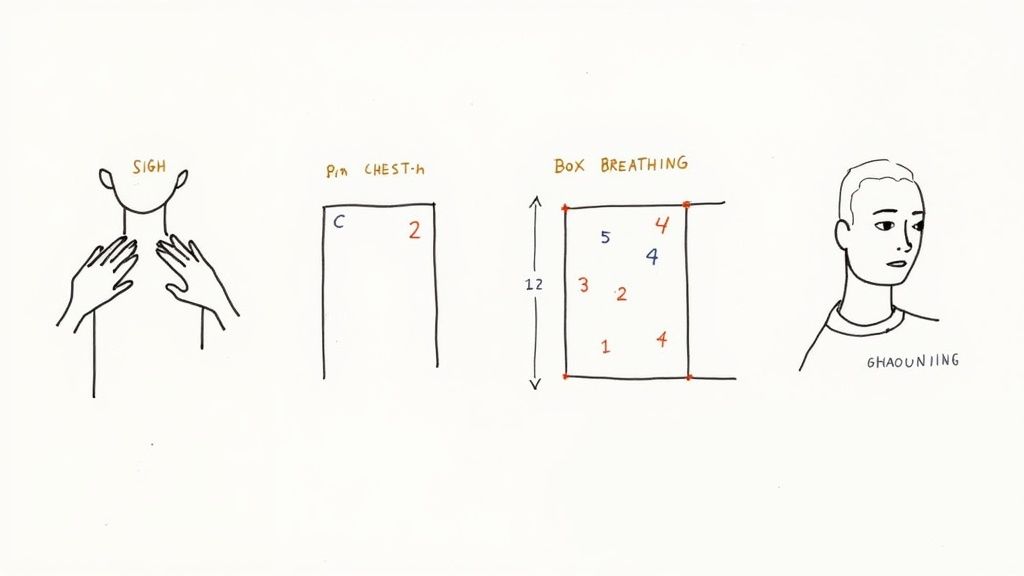
When pressure hits, your body’s alarm system takes over. Your heart races, your breathing gets shallow, and rational thought flies out the window. In these critical moments, you don't need a long-term plan; you need an emergency brake. The following tactics are designed to interrupt that stress response and pull you back into a state of control, fast.
These are discreet, science-backed actions you can use anywhere—right before a big presentation, after receiving tough feedback, or when a project suddenly goes off the rails. The key is to have a small toolkit ready to deploy when you feel that initial wave of panic.
Instantly Reset with the Physiological Sigh
Your breathing is a direct line to your nervous system. When you're stressed, you unconsciously start breathing faster and more shallowly, which only fuels the panic. You can manually override this with a technique called the physiological sigh. It’s an incredibly effective action for offloading carbon dioxide and calming your system almost instantly. Here’s the step-by-step:
- Take two quick, sharp inhales through your nose without pausing. The first inhale fills your lungs, and the second one expands the tiny air sacs even further.
- Then, let out a long, slow, extended exhale through your mouth.
Just one or two of these cycles can dramatically lower your heart rate and bring a sense of immediate relief. Use this as your go-to move for a quick, biological reset.
Ground Yourself with the 5-4-3-2-1 Technique
Anxious thoughts love to pull you into a spiral of "what ifs" and worst-case scenarios. The 5-4-3-2-1 grounding technique is a practical action that yanks your attention out of that internal chaos and forces it back into the present moment by engaging your senses.
The process is straightforward. Wherever you are, silently identify:
- 5 things you can see (your laptop, a pen, a colleague's jacket).
- 4 things you can feel (the texture of your desk, your feet flat on the floor).
- 3 things you can hear (the hum of a computer, distant chatter).
- 2 things you can smell (coffee, hand sanitiser).
- 1 thing you can taste (the lingering taste of your morning tea).
By focusing your brain on concrete sensory details, you starve the anxious thoughts of the attention they need to thrive.
This isn't about ignoring the pressure; it's about anchoring yourself in reality so you can face it with a clear head. You regain control by shifting focus from internal turmoil to external observations.
When feelings of pressure become intense, a practical guide on what to do when overwhelmed can offer immediate relief. For more ideas on how to manage stress naturally, our article on natural stress relief provides additional helpful strategies.
Rewiring Your Mindset with Cognitive Reframing
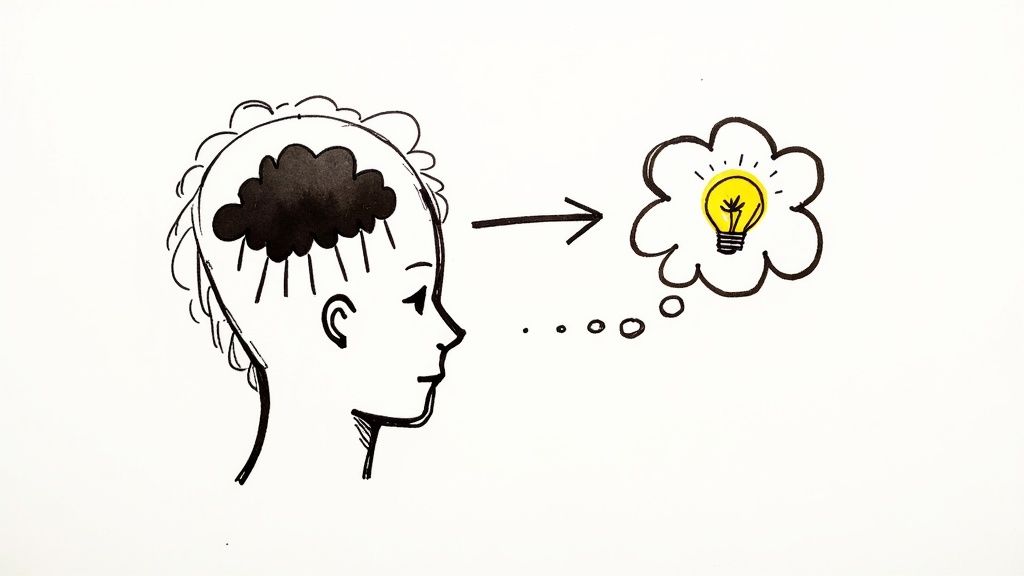
While in-the-moment physical tactics are lifesavers, building lasting calm requires changing how you think. This is where you take action to redefine your relationship with pressure through cognitive reframing. Instead of letting stressful thoughts run the show, you learn to challenge and reshape them. This isn't about pretending problems don't exist. It's about consciously choosing a more constructive viewpoint, a technique rooted in the practical framework of Cognitive Behavioural Therapy (CBT).
Challenge Catastrophic Thinking
When the pressure's on, it's easy for our minds to jump to the absolute worst-case scenario. A tiny mistake on a report suddenly becomes "I'm definitely getting sacked," or a tricky client meeting means "I've completely lost the account." This is catastrophic thinking, and it's a huge source of anxiety.
To stop it, you need to become a detective with your own thoughts. When that doomsday thought pops into your head, pause and take action by asking yourself these direct questions:
- Honestly, what's the real evidence for this?
- What's a much more likely outcome here?
- Even if the worst did happen, how would I actually handle it?
Questioning these automatic negative thoughts strips them of their power. This simple interrogation stops the emotional spiral in its tracks, letting you respond with reason instead of fear.
Reframe Threats as Challenges
How you label a situation completely changes your body's response. Seeing a high-stakes project as a 'threat' flips on the stress switch, leaving you feeling defensive and overwhelmed.
But what if you reframe it as a 'challenge'? This small mental shift can trigger a much more positive, engaged response.
Viewing a tough task as a chance to grow, rather than a chance to fail, is a game-changer. Critical feedback becomes a tool to get better. A complex problem becomes a puzzle to solve. This switch helps you tap into your creativity instead of shutting it down.
These mental tools are more important than ever. In the UK, a staggering 74% of adults have felt so stressed in the past year they felt unable to cope. Learning to manage your response to pressure is a vital skill. You can read more about these stress statistics to get the full picture.
Practice Detached Mindfulness
Here's another powerful technique: detached mindfulness. Instead of getting tangled up in stressful thoughts, you learn to watch them from a distance.
Picture your thoughts as clouds floating by or leaves on a stream. You can notice them without having to jump in and get carried away.
This creates a vital gap between a stressful trigger and your reaction. You can acknowledge the feeling ("Okay, I notice I'm feeling worried about this deadline") without letting it dictate what you do next. It puts you back in the driver's seat, making you the observer of your stress, not its victim.
Building Resilience Through Foundational Habits
While quick tactics are great for putting out fires, the real secret to staying calm under pressure is building a foundation that makes you less reactive in the first place. It’s all about creating a higher baseline of resilience through small, consistent habits.
This means when challenges do pop up—and they always do—you’re already in a much stronger position to cope.
Shifting from a reactive to a proactive mindset is vital, especially at work. The UK has seen a worrying rise in work-related mental health issues, with more and more workers reporting stress, depression, and anxiety. This trend really highlights the need for sustainable ways to manage pressure. You can discover more insights about these workplace trends to get a sense of the scale of the problem.
Prioritise Your Sleep Schedule
Sleep isn't a luxury; it's a non-negotiable part of your stress management system. Poor sleep throws your body’s ability to regulate cortisol, the main stress hormone, completely out of whack. When you're sleep-deprived, cortisol levels can stay elevated, leaving you feeling on edge, irritable, and not equipped to handle the day's pressures.
Here are actionable steps to improve your sleep:
- Aim for a consistent wake-up time: Waking up at roughly the same time, even on weekends, helps regulate your body’s internal clock.
- Create a wind-down routine: For the last 30-60 minutes before bed, step away from screens. Reading a book or listening to calming music tells your brain it's time to switch off.
- Optimise your environment: Make sure your bedroom is dark, quiet, and cool. These small tweaks can make a huge difference to your sleep quality.
Fuel Your Body to Calm Your Mind
The connection between your gut and your brain is powerful and direct. What you eat has a real impact on your mood, energy, and your ability to manage stress.
A diet heavy in processed foods and sugar can lead to energy spikes and crashes, which often just adds to feelings of anxiety. On the flip side, a balanced diet is a fantastic support for your nervous system.
Take action by incorporating more of these into your diet:
- Complex carbohydrates: Foods like oats, brown rice, and quinoa give you a steady release of energy, which helps prevent wild mood swings.
- Omega-3 fatty acids: Found in oily fish, walnuts, and flaxseeds, these healthy fats are well-known for reducing symptoms of anxiety.
- Magnesium-rich foods: Leafy greens like spinach, plus nuts and seeds, are packed with magnesium, which helps relax the nervous system.
Making small, mindful food choices throughout the day is a simple yet powerful way to build a more resilient mind and body. It's not about a restrictive diet but about intentionally nourishing yourself.
To truly stay calm under pressure, it's essential to proactively cultivate a strong inner foundation. Learning how to build emotional resilience is a key part of this journey. For a deeper dive into this topic, you can also explore our guide on how to build mental resilience, which offers further practical strategies. These foundational habits create a lifestyle that makes you naturally better at handling crises.
Proactive Strategies to Reduce Pressure Before It Starts
A significant portion of the anxiety we feel in high-stakes moments comes from the fear of the unknown. The best action you can take is to prepare before the pressure hits. This approach swaps frantic anxiety for a quiet confidence that you can handle whatever comes your way. It’s about shrinking the zone of uncertainty so your response becomes steady and almost second nature when it counts.
Run a "Pre-Mortem" to Spot Trouble Early
We’ve all sat through a post-mortem, picking apart what went wrong after a project has already failed. A pre-mortem is a more proactive, actionable step. Before a big presentation or project launch, get your team together and imagine it has already happened and was a complete failure.
Now, ask the killer question: "What could have caused this?"
This exercise forces realistic problem-solving. It gives everyone permission to voice worries without being seen as negative, helping you uncover risks you’d have otherwise missed. Examples include:
- Tech glitches: "The presentation file got corrupted," or "The video call software died mid-sentence."
- Logistical nightmares: "A key decision-maker couldn't make the new meeting time."
- Information gaps: "We realised we didn't have the data to back up our main point."
Once you've listed these potential issues, you can build backup plans. Thinking through what could go wrong is one of the best ways to stay calm under pressure, because you’ve already done the hard thinking when everything was calm.
A pre-mortem isn't about being pessimistic; it's strategic realism. By facing worst-case scenarios in a controlled way, you rob them of their power to shock and derail you later on.
Mentally Rehearse Your Success with Visualisation
Top athletes, surgeons, and performers use visualisation before a big event. It’s a powerful technique that involves vividly imagining yourself succeeding in a challenging situation, from start to finish. This is more than just "positive thinking"—it's a detailed mental dress rehearsal that gets your brain ready for the main event.
Your brain doesn't always distinguish between vivid imagination and actual experience. When you mentally rehearse, you're building and strengthening the neural pathways you’ll need when the pressure is on for real.
For an upcoming client negotiation, follow these steps:
- Picture the scene: Visualise the room, the table, and where everyone is sitting.
- Run through your key points: Imagine yourself speaking clearly and confidently.
- Anticipate the tricky bits: See yourself handling tough questions or objections without breaking a sweat.
- Feel the win: Imagine the handshake and the sense of accomplishment from a great result.
This mental practice makes the real thing feel less intimidating and more familiar. You're walking into a situation you’ve already aced in your mind.
Use Checklists to Lighten Your Mental Load
When you’re under pressure, your brain's capacity for complex thought—your cognitive load—shrinks dramatically. You’re far more likely to forget small but vital steps. This is where a simple checklist becomes your best friend.
A checklist outsources your memory. It frees up precious mental energy so you can focus on the actual work, not on remembering what to do next. Whether it's a pre-flight checklist for a pilot or a simple to-do list for a difficult meeting, that structure is your safety net. It ensures you don’t miss anything when you're stressed, creating a reliable process that helps you feel composed and in control.
Putting It All Together: Your Calmness Action Plan
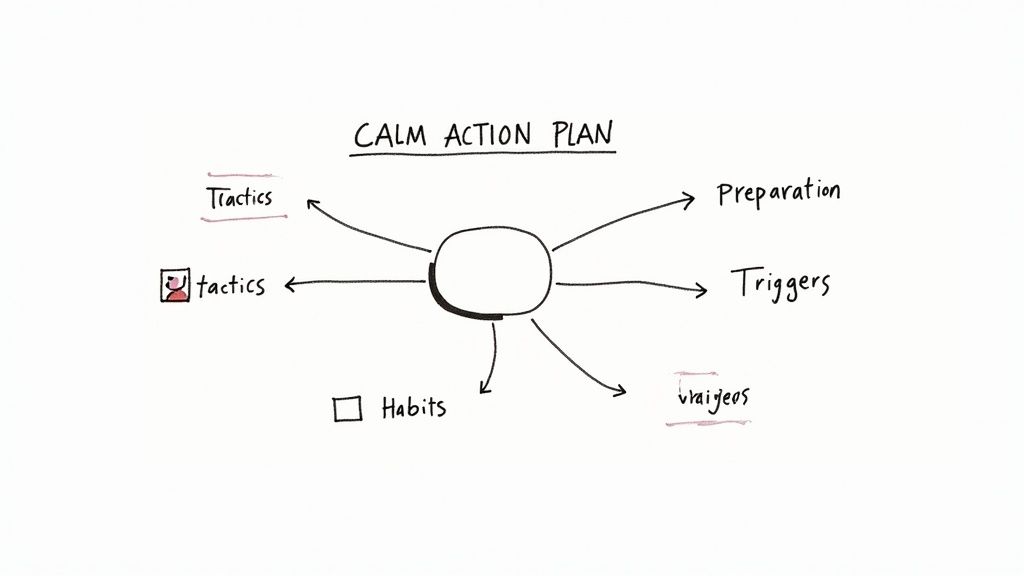
Knowing the theory behind staying calm is great, but real resilience comes from putting it all into practice. It’s time to move from simply knowing to doing.
The goal is to build a simple, personal plan that you can actually use when things get tough. This isn't about some rigid, complex system. It's about making composure a natural part of your professional toolkit.
Real composure doesn't just happen in the heat of the moment; it’s built over time. That’s why your plan needs two key parts: an emergency response for when pressure hits, and a daily routine to build your underlying strength.
Let’s get yours set up.
First, Pinpoint Your Personal Triggers
You can’t manage what you don’t see coming. The first step is getting honest with yourself. Think back to the last few times you felt completely overwhelmed at work.
What was the trigger?
- Was it a project deadline that suddenly moved up?
- Maybe the thought of speaking in front of a big group?
- A tense conversation you had to have with a colleague?
- Or perhaps receiving some tough, critical feedback?
Figure out your top 2-3 triggers. These are the specific situations that consistently throw you off balance. Don't just think about them—write them down. This gives you a clear target to focus on.
Build Your Customised Calmness Toolkit
Now that you know your triggers, you can create a specific game plan for each one. This is about having a menu of options ready to go, so you’re never caught off guard.
Your plan isn’t about finding one single magic trick. It's about building a versatile toolkit, so you can pick the right tool for the job whenever pressure mounts.
For each trigger you wrote down, build a simple, three-part response.
-
Pick Your Go-To Tactic. When that trigger hits, what's the very first thing you'll do? Choose one immediate, physical action. It could be the physiological sigh we talked about, or running through the 5-4-3-2-1 grounding technique. Make it your automatic first move to stop the stress spiralling.
-
Choose a Cognitive Reframe. Next, how will you mentally reframe the situation? If public speaking is a trigger, your reframe might be, "This is my chance to share what I know, not a test." If it's criticism, you could try, "This feedback is just data, not a judgement of my worth."
-
Link It to a Long-Term Habit. Finally, what's one small habit you can build to make this trigger less powerful over time? If presentations are the problem, maybe you practice visualisation for five minutes each morning. If tight deadlines are your weakness, you could make a habit of mapping out potential problems at the start of every project.
By creating this simple, three-step plan for your main pressure points, you create a system you can rely on again and again. You’re no longer just reacting; you’re responding with a plan.
At Oji Shilajit, we believe in building resilience from the inside out. Our enhanced Shilajit gummies are formulated with over 85 trace minerals and adaptogens to support mental clarity, reduce stress, and boost your natural energy. Discover how you can support your body’s ability to handle pressure by exploring our natural solutions at https://myoji.co.uk.


